
Cambodia
piggy bank
Shane chum
For Shane Chum, the idea of home was something that he was denied for much of his youth. Born in 1966, he was displaced during the Cambodian Civil War1. By the time he was four, the Khmer Rogue waged war against the American supported Khmer Republic, with children scarcely older than him fighting on the front lines. He recalled not knowing anything about the war, or what the war was fought over. The destabilizing nature of the war meant keeping count of days was more survival based than sentimental. His hometown of Battambang fell under the influence of the Khmer Rogue, in a year unknown to both him and some historians. The history of the Civil War is something that is still difficult to comprehend, due to the purge of government officials and intellectuals.
After the regime took power, Shane’s residence in Battambang was seized by the Khmer Rogue as part of the Angkar, the political entity that the Khmer Rogue operated behind. The regime was built around the idea of restoring the Khmer people to their glory days; the Khmer Empire whose monumental Angkor Wat is romanticized as a symbol of the Khmer people’s potential and perseverance. This was the hope.
Instead, the Khmer people found themselves at the mercy of a violent regime intent on destroying any outside influence on their nation. Decades of operating in the shadow and closely allying themselves with China and adopting Maoist ideals led to private property being abolished and the divide between the rural inhabitants and city residents. Every Khmer person in Cambodia would be property of the Angkar.
Some of Shane’s earliest childhood memories centered around being caught in the shockwave of this violent regime. After the regime’s takeover, he saw how “they separated the kids into one group, the adults into another”. Families were separated during this period, and the malleable children would be indoctrinated as soldiers. He recalled an anecdote where he was wandering a rice paddy2 and picked some rice off to eat, as the food rations were so restricted that 1.2 million to 2.8 million Khmer citizens died. He was apprehended by a soldier who was armed with a machete and told that if he didn’t stop, he would be killed. From then on, he was a prisoner of the Angkar.
His stint as a prisoner saw little violence towards him. Children under the Khmer Rogue were seen as young and malleable and easily brainwashed into being ideal citizens. Because of this, Shane was spared from torture. Instead, he witnessed a Khmer Republic soldier’s torture at the hands of the Khmer Rogue’s post commander for his association with the former government. He recalled how him and another young prisoner would “go into hiding” at the sight of the commander, fearing a similar fate. Shane’s chance at escape came when the commander’s servant sent him and another boy to grab some supplies for the commander’s supper. He was told to go directly to grab the supplies and come back. He never came back.
From there, he was able to find his family and their assigned home. He would continue to serve in the rice paddies, gathering harvests of rice for the Khmer Rogue. This pattern would continue for another 3 years, working under the regime under the surveillance of the Khmer Rogue. In 1979, border tensions with the Vietnamese government came to a boiling point and an invasion of Cambodia by the Vietnamese army. Slowly, the Khmer Rogue lost control of Cambodia as the Vietnamese forces marched west, ostensibly liberating the people of Cambodia. The defeat of the Khmer Rogue did little to make life easier. He joined the rest of the Khmer population in resettling the abandoned cities. His first opportunity at having a place to call home was something he viewed with apathy, recalling how his reaction was “Oh we move back in? Okay?”. Liberated only in name, the Khmer were still under the control of a new regime as an interim government formed, while the Vietnamese forces swept west, annexing more land from the Khmer Rogue.
The war raged in the background, and though liberated, signs of the conflict still existed in his daily life. He recalled an instance where he walked into a temple, by this period a relic of a bygone era3. The once holy site had been turned into a military cache under the Pol Pot regime, and the Vietnamese had kept the cache in place. He, “Stupid and young as I was” dug through the weapons and picked up a grenade. Mimicking the Vietnamese soldiers he had seen using them, he stood over a bridge and pulled the pin before throwing it into the pond.
Though liberated, his family would end up in the United States by what seemed a stroke of fate. Shane’s mother was inspired by a dream to travel to the Thai border. The two-day trek was grueling, recalling that “the lucky ones survived the journey, the unlucky ones got shot along the way”. At the border camp, the Khmer inhabitants conducted trade with Thai inhabitants. The trade would turn sour, and he recalled how “Next thing you know,… boom boom boom.” Artillery fire from the Thai military had wreaked havoc on the camp, similar to the events at the Dangrek Genocide. Those that escaped the Khmer Rogue would meet the same fates as their compatriots: victims of dehydration, starvation, and executions.
The refugee camp was quickly abandoned in the wake of Thailand’s “human deterrence” policy. His family would pack their belongings and get on the back of another truck to another camp called Khao-I-Dang Holding Center. This camp was under the protection of the Thai Interior Ministry after internation backlash for the actions at Dangrek, and under the supervision of the United Nations High Commissioner for Refugees. He spent a year there, narrowly escaping the forcible repatriations that occurred the year after. It was during his time here that his family was able to reestablish contact with relatives that had moved to America prior, though he had another option to relocate to France. His family that fled the Khmer Rogue prior to their takeover was able to sponsor his exodus.
The journey to America was an improvement. His first step on American soil was in California, before continuing to Chicago, where he considered his first home. Despite the $600, he finally was able to settle into a permanent residence. His first home was in Uptown, living in an apartment between Winthrop and Argyle in 1980. He lived in a one-bedroom apartment with six of his family members: his two brothers, two sisters, and his mother.
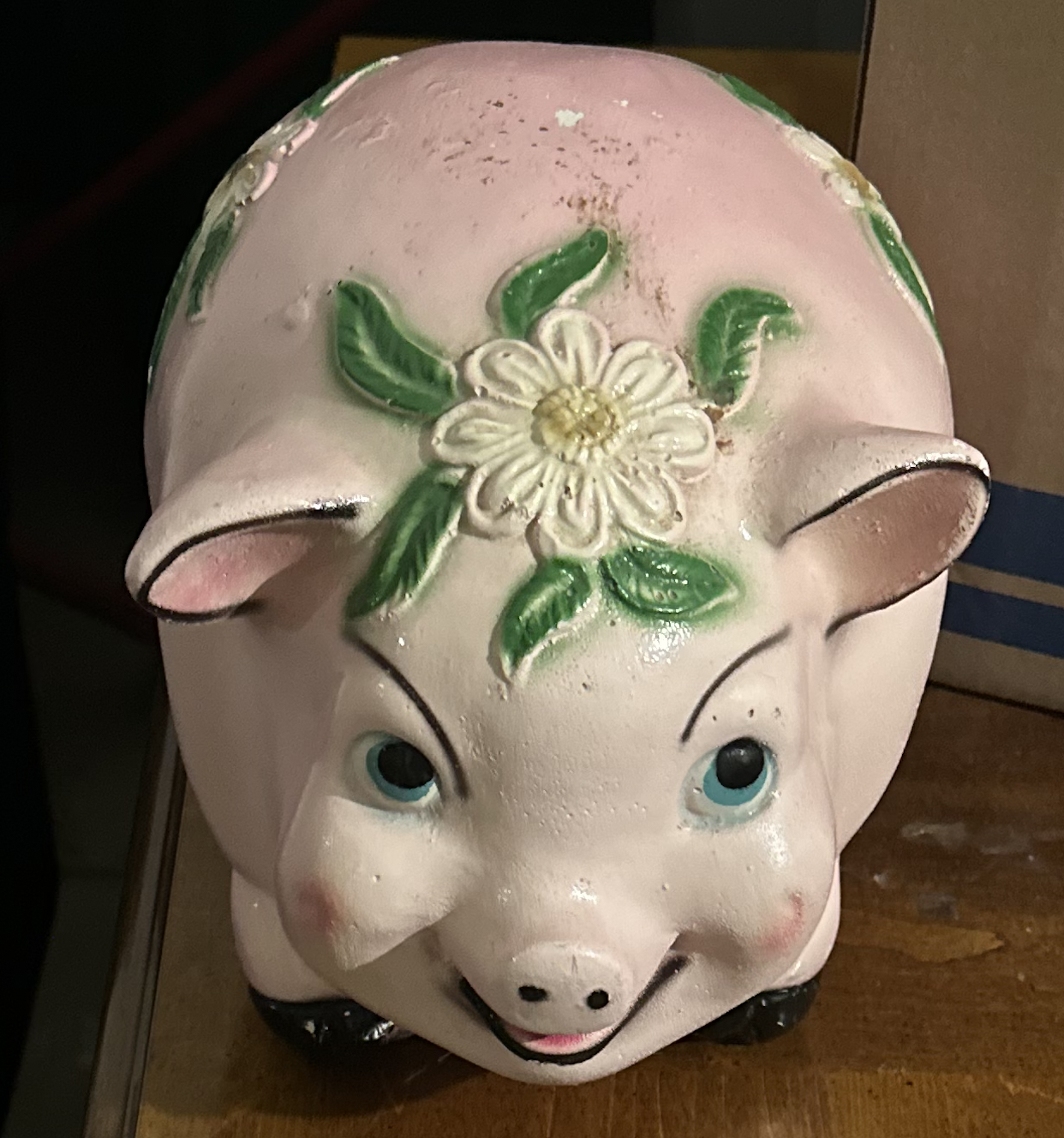
Upon landing on American soil, one of his first purchases was a piggy bank. Roughly the length of a standard textbook. Its face is painted with blue eyes staring lazily up, mismatched black lines along the top of the eyes granting it the appearance of eyebrows. Along the top, there are three white flowers circled with green leaves. The coin slot is in the back, in lieu of a tail. On the bottom, a crack that has seen been mended with a glued layer of plastic mesh. It was one of the first purchases he made in order to budget money so he could support his family. Being one of the primary supporters of his family, what money he had for himself he would save.
Many of the other Khmer refugees would live in Uptown, bound by their shared experiences under the Khmer Rogue and their journey of escape. He would remain in Uptown for ten years along with other Khmer refugees, finding his footing in America. As time went on, many of the Khmer residents would find new careers and left Uptown. Shane moved to Lawrence and Elston, living in the basement of the apartment building his family was able to purchase. He would have two children with his wife, before relocating to the suburbs of Chicago.
Shane was able to graduate high school and earned his diploma, before spending two years at DeVry University before having to drop out to support his family and has since made it his goal to see his children through college. His first job was at a factory for a year or two, to his recollection. He would make a career shift to being a painter. It was around this time that, through a series of reestablished connections with friends and relatives that had survived the Khmer Rouge, he would meet his future wife Tousopheang during a visit to Cambodia. From then, the money in his piggy bank would be for his wedding. Years of savings had shifted from His work consisted of painting houses in the northern suburbs of the Chicagoland area.
When he realized he had enough money saved up, he took a hammer to the bottom and cracked it open, shortly after purchasing a ticket. From then on, the purpose of the piggy bank was to be able to afford a ticket back to Cambodia to be able to marry her. After the wedding, the piggy bank has been in their possession, the primary relic of his story. The first purchase he made after escaping a regime that disavowed private property, and years of bartering personal belongings to be able to live another day. His own property after years of giving to support his family in a new and strange land. And now a relic of the struggles of the past.
*This story, written by Jack Chum, was an outcome of a student project created in HST 269: Museums, Memory, and Material Culture, taught by Amy M. Tyson at DePaul University in Spring 2025.